How Orthodontists Can Win AI Search: A Real-World Case Study
Author: Savvy Lorestani, CEO of Brain Bytes Creative
Summary
- One blog article for an Ohio orthodontic client generated 1,081 AI impressions from May 18 through August, with visibility accelerating sharply over the summer.
- The article shows up in search results for many related topics it wasn’t specifically written to target, helping it reach a wider audience beyond its original keyword.
- The strategy centers on E-E-A-T, topical authority, and verifiable evidence, not content volume for its own sake.
- This post follows the same principles it describes: clear structure, useful answers, and proof readers can verify.
There’s no shortage of advice right now about how to “optimize for AI.” But the strategy we’ve been implementing with our clients is actually more foundational: create genuinely useful, authoritative content around the subjects you want your practice to be known for, then give search engines and AI systems enough evidence to trust you as an expert on those subjects.
This is where E-E-A-T — Experience, Expertise, Authoritativeness and Trustworthiness — becomes so important. We don’t produce content simply because an SEO tool identifies a keyword opportunity. We look for meaningful topics where a practice has real expertise, where prospective patients have real questions, and where the practice can add something credible and useful to the conversation.
Then we build resources worthy of being found, referenced, and ultimately trusted.
One of our orthodontic marketing clients, Carmen Orthodontics in Ohio, gives us a great example of what that strategy can look like in practice.
The Strategy: Build Authority Around a Meaningful Treatment Topic
Last year, we created an article for Carmen Orthodontics comparing custom braces vs. traditional braces.
This wasn’t content for content’s sake. Custom braces are one of Carmen’s core services, and we wanted a resource that clearly explained the treatment, demonstrated the practice’s expertise, and strengthened Carmen’s overall authority around the subject.
In other words: we wanted Carmen to become a source Google could trust when someone wanted to understand custom braces.
Now we’re beginning to see evidence that it’s working.
Generative AI performance data became available for this page beginning May 18. From May 18 through the end of August, the article generated 3,785 total search impressions, including 1,081 impressions within Google’s AI search experiences. And the AI visibility accelerated quickly:
- May: 1 AI impression
- June: 26 AI impressions
- July: 460 AI impressions
- August: 594 AI impressions
- September 1–15: 299 AI impressions
Generative AI Performance from Google Search Console

Total Performance from Google Search Console

One of the top queries generating AI impressions is simply “custom braces.” When we tested that search, Carmen appeared as a cited source in Google’s AI Overview and on page one of the traditional organic results.

- “What are custom braces?”
- “Individualized braces”
- “Customized orthodontic treatments”
- “Custom braces technology”
For several of these searches, Carmen is appearing in AI-generated results alongside strong traditional organic visibility.
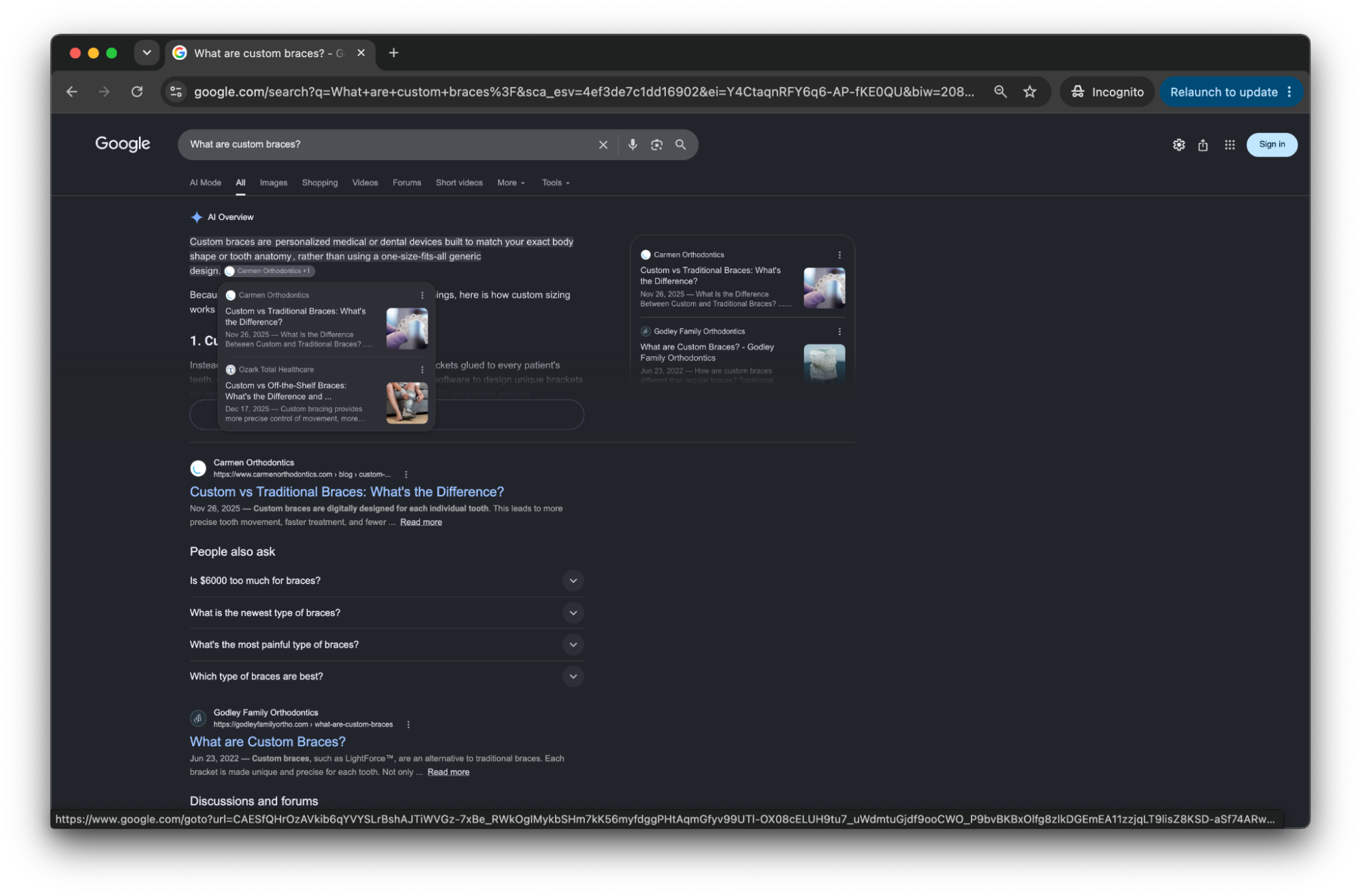
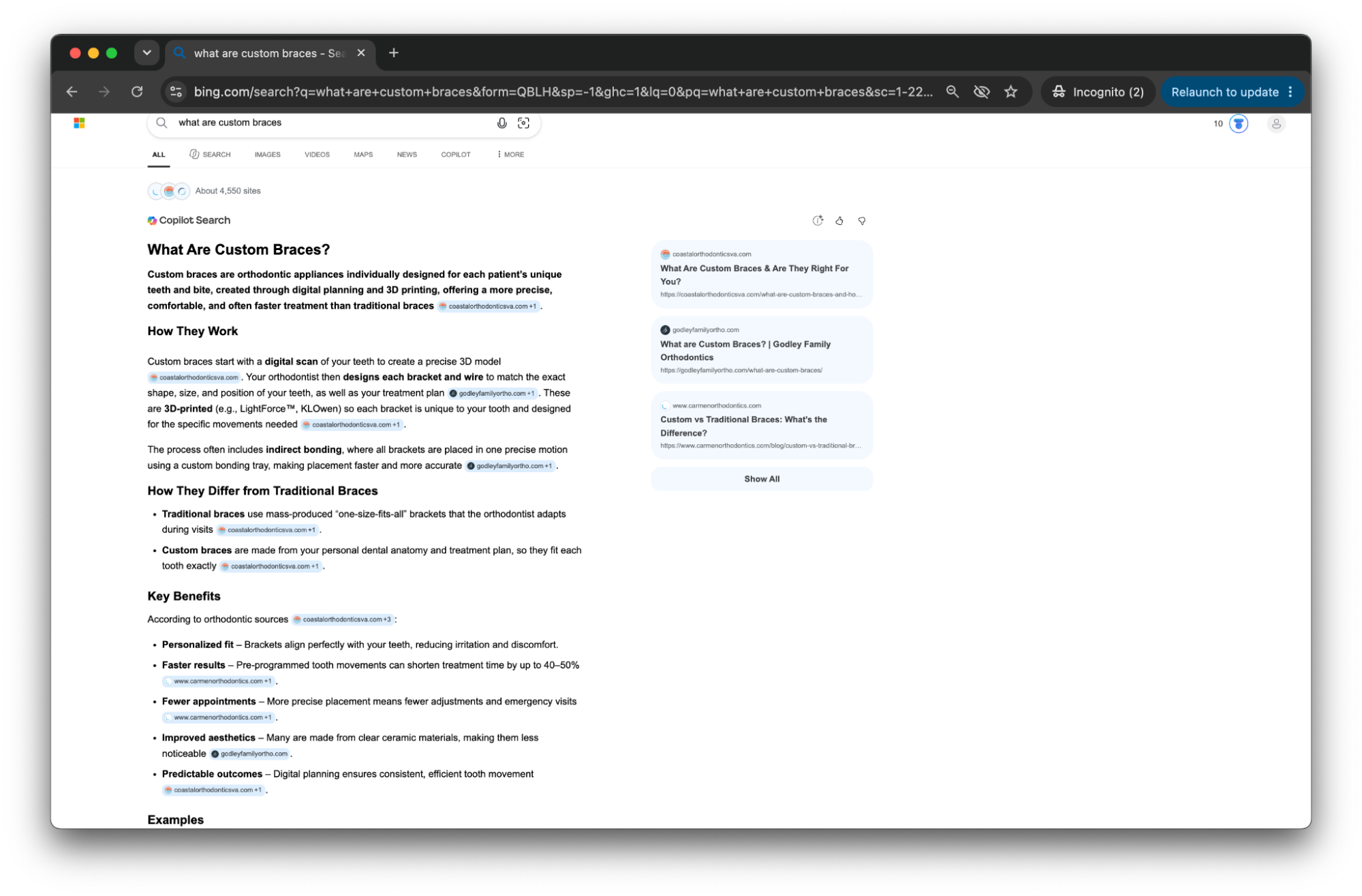
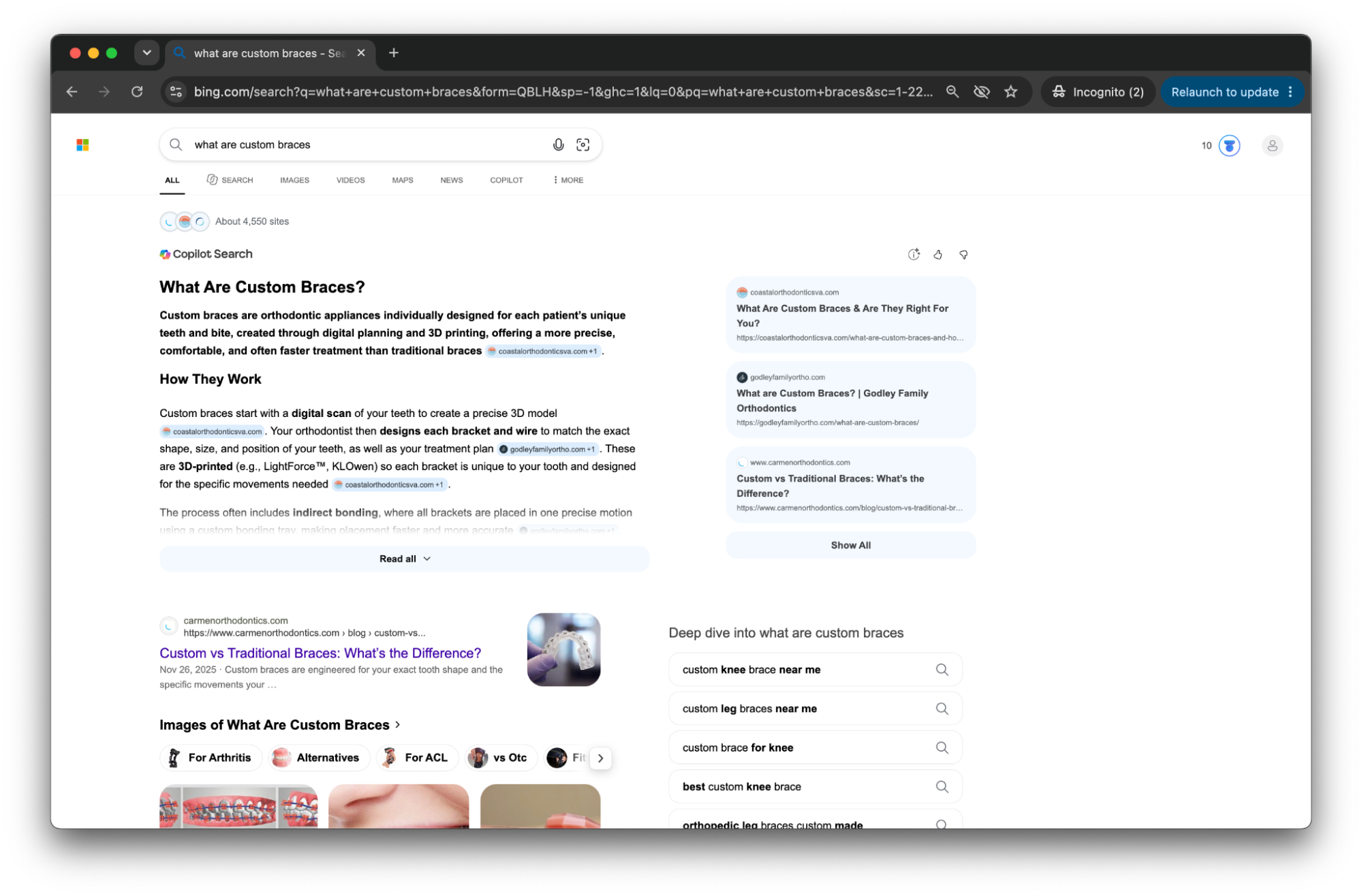
That’s exactly what we’re trying to accomplish. We’re not just trying to rank one page for one keyword. We’re building enough topical authority for search engines and AI systems to recognize Carmen as a credible source on custom braces across an entire cluster of related searches.
What Can Orthodontists Learn From This?
A strong SEO strategy isn’t about publishing simply to maintain a content calendar. Freshness still matters when a topic calls for current information, but every new piece of content should have a clear, strategic reason to exist.
What treatments do you want to be known for? What questions are prospective patients asking? Where do your doctors have genuine expertise? Where can your practice add something meaningful to the conversation?
AI can generate an endless supply of generic information. The opportunity for practices is to create content that is specific, useful, credible, and backed by enough real-world evidence to be trusted and believed.
This is why we’ve been talking about EEAT for years. AI systems aren’t short on information; they’re short on certainty about which information to trust. Your job is to give them verifiable proof: our doctors’ credentials, detailed treatment information, original insights, patient reviews, video, local reputation, third-party mentions, and consistency in the information that can be found about your practice across the web. We don’t want Carmen’s site to simply say “we’re experts in custom braces.” We want to build enough evidence that Google and AI Systems can reach that conclusion on their own.
While national rankings themselves are not the end goal here, that broader visibility is useful because it shows that Google understands the page as a meaningful resource on the larger topic, not just as a match for one exact phrase.
This is part of query fanout: one well-developed resource can become relevant across multiple related questions, concepts, and search paths. The goal isn’t to create a separate page every time the wording changes. It’s to understand the broader subject deeply enough to build content that can satisfy the different ways people explore it.
For an orthodontic practice, that broader authority should ultimately support the searches that matter most commercially: prospective patients researching treatment options, evaluating expertise, and choosing a provider in the markets the practice actually serves.
The custom braces article isn’t an island; it’s intentionally linked to the treatment, doctor, and location pages that matter most to the practice because the goal isn’t simply to generate traffic to one blog post. We want the authority created by that content to strengthen the entire website.
During the most recent reporting period, Carmen’s homepage, location pages, and doctor bio page were among the site’s strongest-performing pages, and several Ohio locations saw meaningful gains in sessions and conversions.
Can we say one custom braces article caused all of that? Of course not. There are multiple strategies working together, including ongoing SEO and broader Search Everywhere Optimization efforts across local search, Google Business Profiles, reviews, video, third-party platforms, and other authority signals.
But that’s precisely the point: AI Search shouldn’t be a standalone tactic. Content, site architecture, local SEO, reviews, Google Business Profiles, video, third-party mentions, and other signals should reinforce one another and build a stronger body of evidence around the practice as a whole.
Frequently Asked Questions
Do I need to create more content to show up in AI search results?
While publishing more content can absolutely help, volume alone isn’t the goal. The priority is to create useful, authoritative resources around topics where your practice has genuine expertise, then connect those resources intelligently across your site.
A steady stream of strong content can expand the subjects and questions your practice is eligible to appear for, but publishing dozens of shallow articles simply to increase your page count is unlikely to build the kind of authority AI systems are looking for.
How long before I see AI impressions like this?
Carmen’s article had been live for about a year when Generative AI performance data became available in Google Search Console. Google began reporting AI performance on June 3, with data for this article available dating back to May 18.
The more meaningful signal is what happened next: visibility increased sharply around June 30 and has remained consistently elevated since then.
That doesn’t mean every article needs a year before it can gain AI visibility. It does show why we treat authority-building as a long-term strategy rather than something that produces predictable results on a fixed timeline.
Does this work for smaller or single-location practices?
Yes. The underlying principles are the same regardless of practice size: demonstrate real expertise, support it with credible evidence, and connect that expertise clearly across your website and broader search presence.
Smaller practices can sometimes move faster because they often have fewer layers of legacy content and site complexity to work through. The advantage isn’t size itself; it’s the ability to build a focused, consistent body of authority around the treatments and topics that matter most.
What’s the single highest-leverage thing to fix first?
Start with one treatment or topic your practice is genuinely strong in and ask whether your website gives search engines enough evidence to understand that expertise.
Build or improve one authoritative resource around that subject, support it with your doctors’ experience and other verifiable proof, and connect it to the relevant treatment, doctor, and location pages. Then expand from there.
The Bigger Lesson: Give AI a Reason to Choose You
If you want your orthodontic practice to win AI search, don’t start by asking “How do we optimize for ChatGPT or Google’s AI Overview?” Ask instead: “What would make an AI system confident enough in our expertise to use us as a source?”
Then build that evidence systematically. Create exceptional treatment content. Demonstrate your doctors’ expertise. Answer the questions real patients are asking, especially in the markets you serve. Earn great reviews. Strengthen your Google Business Profiles. Create useful videos people find real value in watching. Build third-party mentions and citations that prove that others see you as a source, too.
Most important of all: connect all of those signals intelligently.
This is why we talk so much about Search Everywhere Optimization. Your website remains critically important, but your authority doesn’t begin and end there. The goal is to create a consistent body of evidence across your website, Google, reviews, directories, video, social platforms, and other trusted sources that gives patients and AI systems the same reason to trust you: these people know what they’re talking about.
A summary up top, clear structure, an FAQ section built around the questions people actually ask, and verifiable proof of the results we’re talking about throughout. These are all signals that make content easier for people to scan, easier for search engines and AI systems to understand, and more credible when you’re making claims about expertise or performance.
This post is built using the same principles we’ve been describing throughout the article. We didn’t just say Carmen gained AI visibility; we included the performance data and search-result screenshots to show it.
If you want to see what this could look like for your practice, reach out and schedule a complimentary assessment with our team.